5 min read
Credit card EMI interest in India: 16% or 30%, plus 18% GST
An EMI on your credit card feels like the sensible choice. A ₹1,00,000 phone becomes ₹9,000 a month, and the bill stops looking scary.
What the EMI screen rarely shows clearly is the rate. In India, credit card EMIs usually cost somewhere between 16% and 25% a year. And depending on how the EMI was created, the same purchase can cost close to 30%. On top of that, you pay 18% GST on every rupee of interest, every month.
Here is how to tell which EMI you have, and what it actually costs.
How much interest do credit card EMIs charge in India?
Most credit card EMIs fall in the 16% to 25% a year range. Where yours lands depends mostly on one thing: who created the EMI.
- The merchant set it up at checkout. When you choose EMI while paying on Amazon, Flipkart or at a store counter, the EMI is arranged between the bank and the merchant. These are usually the cheapest, often around 16%, and sometimes partly paid for by the merchant or brand.
- You converted it yourself afterwards. You bought something at full price, then opened your bank's app and converted that transaction to EMI. These conversions are priced by the bank alone and are usually the most expensive. Rates close to 30% a year are not unusual, and many banks add a one-time processing fee on top.
The interest rate is the same kind of thing in both cases. The price is not. Before you convert a purchase to EMI, ask your bank for the exact conversion interest rate and processing fee. It's printed in the conversion screen's small print, or customer care can tell you in a minute.
Why does converting a purchase to EMI yourself cost more?
Because nobody else is paying part of the cost.
A checkout EMI is a sales tool. The merchant wants the sale, the brand wants the sale, and the bank wants the customer, so the rate is competitive and is sometimes subsidised. That's also how "no-cost EMI" works: the interest is real, but the merchant gives you an equal discount up front.
A conversion after the purchase has no merchant involved. The sale has already happened, and the bank is effectively offering you a personal loan on a purchase you've already made. It prices that like the convenience it is.
Do you pay GST on credit card EMI interest?
Yes. 18% GST is charged on the interest part of every EMI, every month.
Interest on a credit card EMI counts as a financial service, and financial services carry 18% GST. Each EMI is really three lines on your statement:
- Principal, the part that repays what you bought. No GST.
- Interest, the bank's charge for the loan.
- GST, 18% of that month's interest.
Here's a real-shaped example from cardkhata's demo account: a 12-month electronics EMI on an Axis Bank card, instalment 9 of 12.
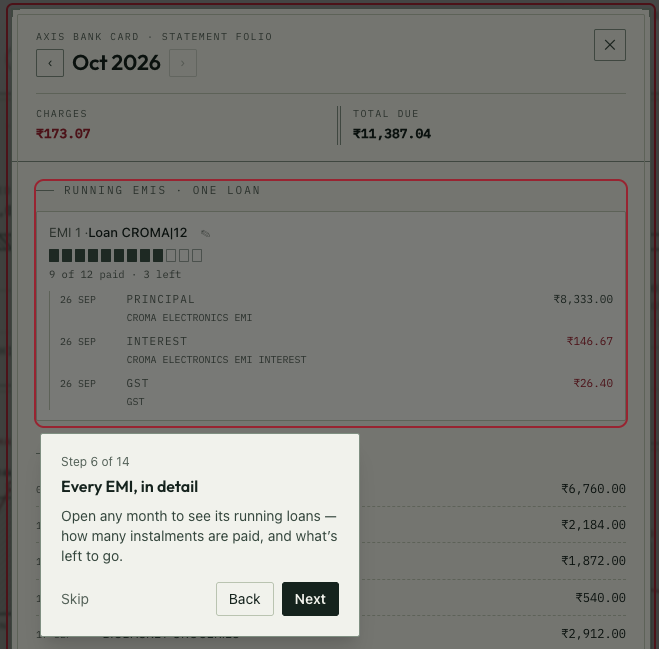
₹146.67 of interest, and ₹26.40 of GST on it, which is exactly 18%. The same applies to the processing fee: if your bank charges one, GST is added to it too.
This catches people out with no-cost EMIs. The merchant's discount covers the interest, but the GST on that interest is still yours to pay. That's why a "no-cost" EMI often shows a small GST charge every month.
What does a credit card EMI really cost? A worked example
Take a ₹1,00,000 purchase on a 12-month EMI. Credit card EMIs charge interest on the reducing balance, so each month's interest is smaller than the last.
At 16% a year (a typical checkout EMI):
- Monthly EMI: about ₹9,073
- Total interest over the year: about ₹8,877
- GST on that interest: about ₹1,598
- Total cost of borrowing: about ₹10,475
At 30% a year (a costly self-converted EMI):
- Monthly EMI: about ₹9,749
- Total interest over the year: about ₹16,985
- GST on that interest: about ₹3,057
- Total cost of borrowing: about ₹20,042
Same phone, same 12 months, roughly ₹9,500 more just because of how the EMI was set up. And the EMI figure your bank quotes usually leaves out the GST, so the amount that actually leaves your account each month is a little higher.
If you want to check a quote yourself, the standard formula is:
EMI = P × r × (1 + r)^n / ((1 + r)^n − 1)
where P is the amount, r is the yearly rate divided by 12 (16% becomes
0.01333), and n is the number of months. Total interest is EMI × n − P,
and the GST is 18% of that.
How do you keep track of every EMI you're paying?
This is where it usually goes wrong. One EMI is easy to remember. Three EMIs across two cards, started at different times, are not. Each one adds three lines to every statement for months, mixed in with your regular spending.
cardkhata reads your statements and pulls the EMIs out for you:
- How many EMIs are running, across all your cards, on the overview.
- Every loan, month by month: which instalment you're on, how many are left, and that month's principal, interest and GST, shown separately.
- Fees, interest and GST for the cycle in one line, so the cost of borrowing is never hidden in the transaction list.
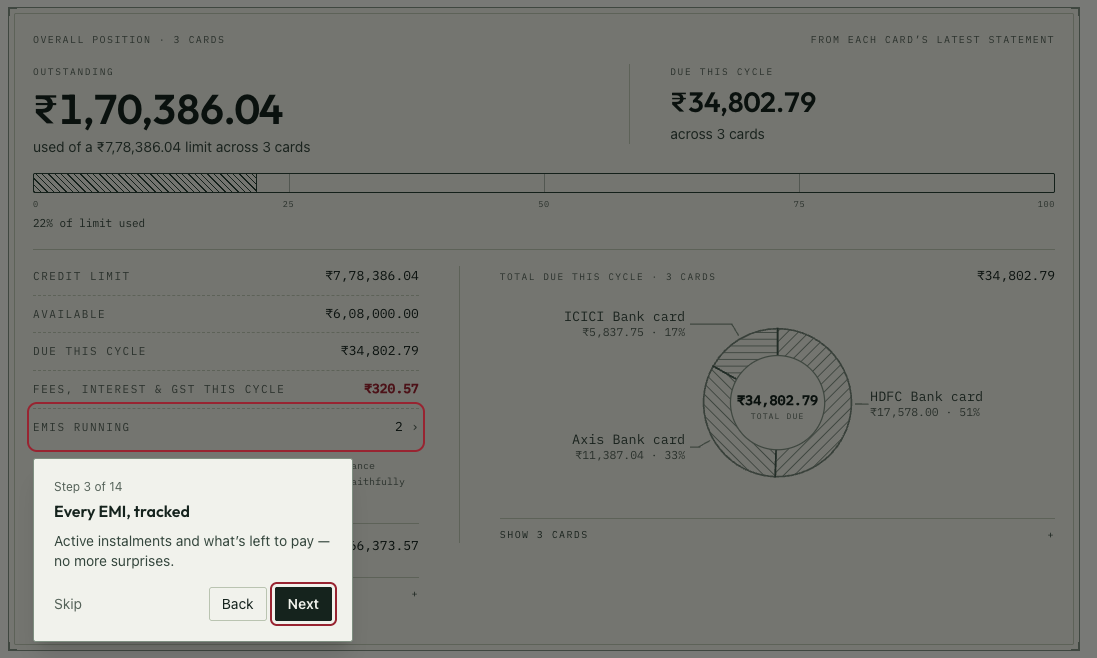
When you can see that an EMI is costing you ₹170 a month in interest and GST, it becomes an easy decision whether to close it early. Many banks allow early closure, usually for a small foreclosure fee.
Before you take your next EMI
- Prefer the checkout EMI over converting later. If you're going to pay in instalments anyway, choose EMI while paying.
- Ask for the conversion rate and processing fee before converting a purchase yourself. If it's close to 30%, a cheaper personal loan or just paying in full may well cost less.
- Count the GST. Add 18% to every interest figure you're quoted.
- Read "no-cost" carefully. The interest may be covered, but the GST on it usually isn't.
- Keep a running list of your EMIs, or let your statements keep it for you.